
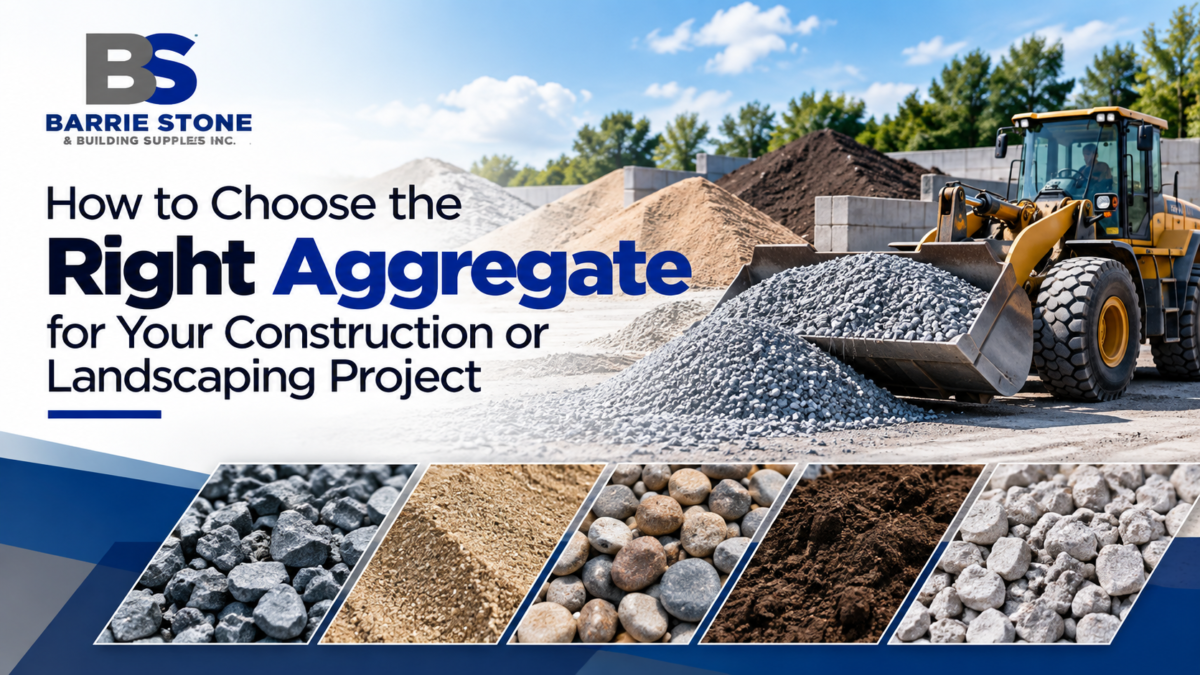
How to Choose the Right Aggregate for YourConstruction or Landscaping Project
What Are Aggregates?
Aggregates are essential materials used across construction, landscaping, and infrastructure projects.
Common examples include crushed stone, gravel, sand, and recycled concrete. They can be used for road construction and base layers, concrete and asphalt production, drainage systems, foundations,
landscaping, and grading.
Choosing the right aggregate for a project can affect drainage, stability, durability, and the overall
performance of the finished work.
Why Does the Right Aggregate Matter?
Different projects require different material properties. Some applications need strong compaction and
stability, while others depend on drainage or a smooth bedding layer.
Selecting an aggregate based on how it will be used helps ensure the material performs as intended.
Project requirements, site conditions, required quantity, and delivery needs should all be considered before ordering.
Common Aggregate Types and Their Uses
3/4″ Clear Stone
3/4″ clear stone is washed limestone with little to no fines. Its structure allows water to pass through easily, making it suitable for drainage, backfill, weeping tile coverage, French drains, and under-slab drainage.
3/4″ Crusher Run
Crusher run is a blend of crushed stone and fines that compacts tightly. It is commonly used for driveway
bases, parking areas, pathways, construction pads, and other applications where a stable, compactable
base is needed.
HPB — High Performance Bedding
HPB is a clear, free-draining aggregate used as a bedding layer for pavers, patios, walkways, and drainage applications. It can be screeded easily and does not require the same type of compaction as crusher run.
Screenings
Screenings are finely crushed stone particles used for leveling and interlock or patio base preparation.
They are useful for creating a smooth, compact surface for paving and finishing layers.
River Stone
River stone in the 2–4″ range is a larger, rounded aggregate used for drainage channels, culverts, swales, washout control, erosion-control applications, and landscape accents.
Bulk Aggregates vs. Bagged Materials
The quantity of material required depends on the size and scope of the project. Smaller landscaping jobs
may use bagged materials, while larger construction, commercial, or contractor projects often require bulk
supply.
Bulk ordering can simplify material planning for larger jobs and can be paired with truck delivery. Barrie
Stone offers bulk material options and delivery services designed to support larger-volume projects.
Why Delivery Matters
For construction and landscaping projects, material availability is only part of the process. Delivery timing
and site access can also affect project schedules.
Barrie Stone provides delivery to select commercial and contractor service areas across Ontario. Orders are typically scheduled within 1–2 business days after confirmation, although timing can vary due to weather, traffic, truck and driver availability, and order volume. Customers should also ensure that the delivery site has safe truck access and adequate unloading space.
Choosing an Aggregate Supplier in Ontario
When selecting an aggregate supplier, consider more than the material itself. Look at the supplier’s
available aggregate types, bulk quantities, delivery options, service area, ordering process, and ability to
support your project requirements.
Barrie Stone & Building Supplies Inc. supplies aggregates, soil, and salt solutions, with products and delivery options for contractors, commercial projects, landscaping, and construction applications across Ontario.
Ready to order? Get a delivery quote
Send us your project details and we will confirm the material, quantity and delivery time.